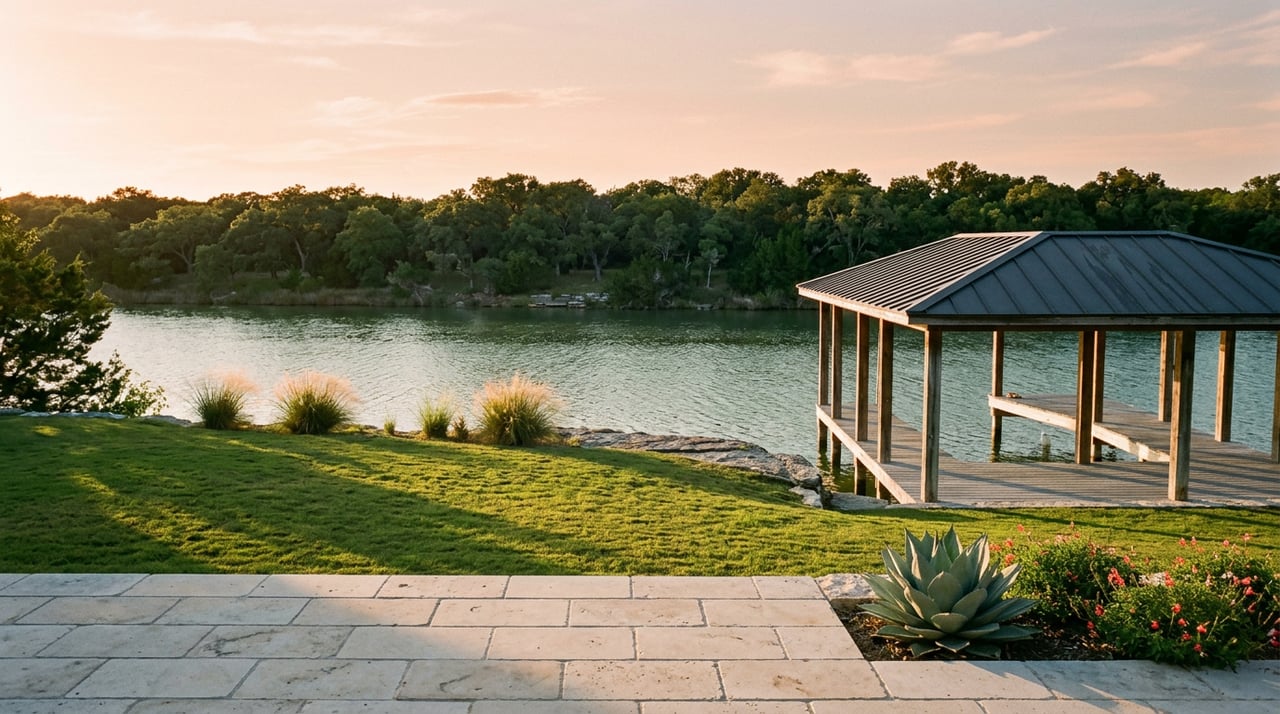
Sometime in mid-July, Lake Travis crossed 681 feet above mean sea level for the first time since 2019. That is full pool, and seven years is long enough that an entire wave of Central Texas homebuyers has only ever known the lake sitting low. Sometimes Island, the drought-exposed sandbar near Mansfield Dam Park, had been visible off and on for years. The tops of the island do not show until the lake drops below 670 feet, a full eleven feet under the mark that counts as full pool. As of August 9, the reservoir sat at 99.2 percent of conservation capacity, according to the Texas Water Development Board's tracking. The island is back under water. Coves that had been mudflats for years are open again.
If you have been watching Lakeway real estate from outside the market, you might expect that to show up plainly in price data. A fuller lake, more usable shoreline, more boats on the water on a Saturday afternoon. It has not shown up that way, at least not in the direction most people assume.
The Number That Actually Moved
Here is the contradiction worth sitting with. Through the stretch when Lake Travis filled back up, Lakeway home values did not show a consistent rally across the trackers. Zillow's home value index put the average Lakeway home at $744,928 as of May 31, 2026, down 2.5 percent over the prior year. Redfin's tracking for the three months ending April 2026 showed a median sale price of $790,000, homes taking an average of 76 days to sell compared with 58 days the year before, and 94 homes sold in April versus 117 the April prior. Redfin's own most recent monthly figure, reflecting July 2026 sales, put the average price closer to $899,000, up 9 percent year over year, which tells you as much about how differently trackers measure "average" versus "median" as it does about the market itself.
The disagreement gets more pronounced from there. Movoto recorded a May 2026 median of $849,000 with days on market stretching to 98, up from 71 the year before. Orchard's trailing 30-day figure, last updated in early June 2026, showed a median of $785,000, down 4.8 percent year over year, but with days on market actually shrinking to 29 from 54. Four trackers, four different stories about direction and speed.
The mixed readings do not show a clear, consistent lake-level bounce that can be tied to buyers racing to capitalize on the fullest reservoir in seven years, and waterfront listings specifically were no exception. As of January 2026, before this year's rains had even started refilling the lake, waterfront inventory in Lakeway was already averaging around four months on market. The water coming back did not compress that.
Why the Premium Doesn't Track the Water Level
The instinct to connect lake level and price makes sense on the surface. More water, more boating days, more reasons to want to be there. But the waterfront premium in this market, generally cited in the range of 40 to 80 percent over a comparable non-waterfront home in the same ZIP code, has held up through entire market cycles that had nothing to do with rainfall. During the 2022 to 2023 rate correction, when the broader Austin market cooled hard, that premium compressed less than the rest of the residential market did.
That resilience comes from three things, and none of them change when it rains.
The first is scarcity. Lake Travis has a fixed amount of shoreline, and the Lower Colorado River Authority limits how much new development or new marina capacity can be added to it. You cannot build more waterfront. The second is income potential. Waterfront homes have consistently commanded stronger short-term rental returns than inland comparables, which underwrites part of the premium independent of anyone's personal enjoyment of the view. The third is that the lifestyle itself is not reproducible. No amount of capital creates more open water on a landlocked lot.
A full lake makes the amenity more usable this month. It does not create more shoreline, and it does not change who can legally build a dock where. That is the mechanism, and it helps explain why the mixed price readings do not show a consistent spike alongside the water level.
What to Check Before Buying on the Lake
Here is where it gets specific to actually buying a house on this lake, and where a lot of buyers get surprised well after closing.
A dock photographed today, with the lake at 99 percent, tells you almost nothing about what that same dock looks like in a drought year. Lake Travis spent roughly seven years below full pool before this summer, low enough for long stretches that Sometimes Island sat exposed rather than submerged. A cove that reads as deep, private, walk-out water access in August 2026 photos can leave a boat sitting on dry caliche in a future dry spell if the underlying bathymetry is shallow. Listing photos cannot show this, because they are taken at whatever level the lake happens to be when the photographer shows up.
The practical fix is to pull the lake level history for the specific cove or point, not just the lake overall, and compare it against the property's actual water depth at conservation pool rather than at today's flood-adjacent level. That is a due diligence step, not a nice-to-have, for anyone buying with the expectation of keeping a boat at the house.
There is also a regulatory line worth knowing before you get attached to a specific dock plan. The LCRA does not require a permit for residential docks of 1,500 square feet or less. Anything larger, or any floating structure that crosses that threshold, falls under the Highland Lakes Marina Ordinance, which brings in additional insurance, water quality, and safety documentation requirements. If a property's appeal rests on a larger dock than what already exists, that size difference is a permitting question before it is a construction question.
What Your Money Actually Buys, Community by Community
Lakeway is not one market. The sub-communities differ enough in structure that the median price for the city as a whole tells you very little about any specific street.
| Sub-community | What defines it | Rough price positioning |
|---|---|---|
| Rough Hollow | 100-slip Yacht Club Marina with on-site dining at Canyon Grill, keeps a boat steps from home without a private dock | Roughly $700K to $2.5M+, with waterfront frontage typically starting near $1.8M |
| The Hills of Lakeway | Gated, golf-course lots, elevated Hill Country views | Roughly $800K to $2.8M+ |
| Flintrock Falls | Gated community anchored by a Jack Nicklaus Signature golf course | Not broken out separately in available data, but golf frontage anchors value here the way lake frontage does elsewhere in Lakeway |
| Serene Hills | Newest construction still zoned to Lake Travis ISD | From the mid-$500Ks |
| Old Lakeway | The original 1960s-era sections, no golf or marina premium built in | Non-waterfront homes generally start around $500K |
The Rough Hollow model is worth pausing on, because it solves the dock-depth problem described above by sidestepping it. A resident there can keep a boat at the marina rather than at a private dock, which means the household is not exposed to a single cove's bathymetry the way a private waterfront lot owner is. That is part of why the community carries a premium even for homes that are not directly on the water.
For residents without a marina membership or a private dock, Hurst Creek MUD Park and Boat Ramp on the north side of Lakeway provides public launch access, and Lakeway Marina, Emerald Point, Volente Beach, and Ski Shores round out the options elsewhere on the lake.
What This Means If You Are Actually Deciding Right Now
The lake being full is genuinely good news for anyone who wants to use it this year. It is not, by itself, a signal that prices are about to move. If anything, the current stretch of longer days on market across most trackers means a buyer has more room to negotiate on a waterfront property than the "fullest lake in seven years" headlines would suggest. The full pool changes what the property does for you today. It does not change what the LCRA will let a future owner build, and it does not change how many acres of lake bottom exist.
A Few Questions Worth Asking Before You Write an Offer
Does a full lake mean now is a good time to buy on Lake Travis? It is a good time to use the lake. Whether it is a good time to buy depends on the specific property's price relative to the softer, slower-moving market most trackers are currently showing, not on this month's water level.
How do I know if a dock will still work during the next drought? Ask for the lake level history at that specific cove, not just the lake average, and confirm the dock's depth at conservation pool rather than at today's near-flood level.
Is the waterfront premium likely to shrink now that the lake is full and inventory is easier to browse? Unlikely on its own. The premium is tied to permanent shoreline scarcity, LCRA permitting limits, and rental income potential, not to whether the reservoir happens to be full this particular summer.
If you are trying to figure out what a specific Lakeway address is actually worth, water level history included, Roxanne Escobedo works this lake corridor closely enough to pull that history before you ever make an offer. Schedule a confidential consultation to talk through the property, the cove, and what the numbers actually say once you look past the median.
This article is general information, not legal, tax or financial advice. Consult a qualified professional about your situation.